Wednesday, November 5, 2014

Critical Research

How do you meet critical research?

I find critical research fascinating.  It has the ability to tackle an issue that may leave out certain populations, figure out who receives both harms and benefits, and then provide possible solutions. Once a critical  perspective tackles the issue, the players can get back up and begin a new play--even back up and punt.  Critical theory can give a researcher the tools to deconstruct a scenario and figure out the best way to proceed in order to ensure equity.  Whew....that's a lot.

I have an aversion to this particular methodology simply because of the "heart" of this philosophy:  critique.  I think that so much of what we do as educators receives critique that I'm almost uncomfortable with initiating critique myself.  Sure, I have issues with programs that I'd like to change, but do I really want to be THAT person?  I could be.....a wise teacher once told me that I shouldn't complain unless I offer a solution to the problem that causes me to complain.  Critical research surely supports her advice--a mantra that I've tried to adopt.

What research questions does a critical perspective open for you?

If I consider my role as a practitioner, I could use a critical perspective to answer the following questions:


  • How can a school increase diversity in high-stakes, college-level courses?
  • How can a school system increase diversity in gifted and talented programs?
  • How can the gender of individual students effect performance in all boy or all girl settings?
  • How can formative and summative teacher evaluation affect future teacher performance?

Saturday, November 1, 2014

My First Experience with a Dissertation Defense


I had more than good luck on my side when I chose to join Caroline Beam and her dissertation committee for her defense of Perceptions and Enactment of Instructional Coaching in North Carolina.  In fact, I could not be more pleased with my choice, for her defense not only peaked my interest about the concept of liminality and the methodology of portraiture but also allayed my fears about the dissertation defense.

Beam began her presentation with a discussion of her theoretical framework:  liminality, a threshold that maintains a sense of ambiguity because its inhabitants may feel between two stages in life. This idea speaks to me on both a personal and a professional level, for I feel that I have lived in the liminality between teaching and administration for the last three years.  Beam’s discussion of two books, The Magic Toyshop and Borderlands, gave me resources to peruse in my own research, understanding, and even self-preservation; moreover, her discussion provided me with a concrete explanation of what I believed was phenomenon unique to my own experience.  From her dialogue, I gained insight on thresholds, ambiguity, invisible space, and multiple identities.  I was honestly comforted by the knowledge that I am not the only professional who has experienced this loneliness and that I can find literature which can bring me more illumination. 

Beam answered her research questions concerning the role of the instructional coach through creating three individual portraits of successful instructional coaches.  She explained that the book Art of Science and Portraiture gave her the tools to tell these “stories” of her subjects with an artistic flair.  Her methodology incorporated a blended approach that included both empirical and aesthetic evidences.  Not surprisingly, I look forward to learning more about processes of portraiture that seem to include place, purpose, preparation, and perimeters of subjects.   I am also curious to know more about this type of dissertation that is both readable and positive, for it provides an appreciative approach to research.  I don’t particularly like complaining, but I do often feel the need to discuss issues and understand why problems exist.  I feel confident that I will read more about portraiture in my search to start this process for myself.

Beam’s confidence and comfort during her presentation provided me with a wealth of understanding and reassurance concerning this process.  When I ask my own students to present information, I ask them to prove to me that they are “experts” in their topics of choice.  Without a doubt, Caroline proved herself to be the expert in the room on liminality and the role of the instructional coach.  She was comfortable in that space, and she was well received by the evaluators in the room.  In fact, there was no need for her to be defensive at all.  The committee members asked questions that furthered the conversation rather than detracted from her research, and I found myself feeling proud of Caroline once she finished sharing her accomplishments with those who wanted to listen.  My big takeaway from this event is my own honest excitement to develop and complete my own research, paper, and defense.

Experiencing this defense was for me somewhat therapeutic.  Even though I do not question my own decision to embark on this Long Doc Road, others do (and they do often).  My work friends are proud of me, but many of my colleagues think that I’ve pushed myself to do too much.  They question how I can work and go to school, how I can be a mom and go to school, and how I can drive up the mountain once a week.  For me the answer is simple:  “I can do all of this because I want to.”  I want to feel the same sense of accomplishment that I suspect Caroline Beam feels right now.  Her long doc road is coming to an end, and I’m sure that she will have to make some decisions about where to turn next.

Monday, October 27, 2014

Behind Behind the Beautiful Forevers

In my six hour drive from West Virginia to North Carolina earlier today, I had an opportunity to listen to Katherine Boo's author's notes at the end of her Behind the Beautiful Forevers.  Honestly, I was shocked that she began her explanation and reflection with her experience/relationship with a man.  However, I was not surprised to hear her voice in the explanation of her rationale, her methodology, and the obstacles that she faced during this process.  I find it interesting that Boo wanted to find the book that would answer some of her questions, for she did not feel like she was able to write about these people from Airport Road.  She was an outsider.  Since her background is reporting on events and scenarios that most likely do not involve her, readers would expect her to be an outsider.

I did enjoy hearing her reflections on the research process--most significantly how she was "mindful of the risk of overinterpretation."  I respect her recognition that language was an issue in her understanding of individual stories.  She knew that there was more to learn than what she could learn through language and that she needed to overcome language barriers yet continue to make meaning of what she observed.  I think that this would be hard to do, for I think that human nature pushes us to inquire.  I'm not typically satisfied with knowing THAT an event occurs; I want to know the CAUSES and EFFECTS of that occurrence.  Boo makes meaning of the events of Annawadi, and she must interpret without interjecting too much of her own thoughts--she reveals as much truth as possible.

Something else that I found interesting and completely believable is that Boo recognizes that children are more truthful than adults.  As a parent of two children (12 and 8), I agree with her proposition, for my own boys are sometimes brutally honest.  "Mom, what's wrong with your hair."  "Mom, do we have to have something fancy tonight?  Can't we just have spaghetti?  "  However, we adults learn that there is a lot of gray between truths and untruths.  Sometimes we reveal and conceal information based on out level of trust with those whom we communicate.  For example, if my local paper were to ask me what I think about any general district policy, I would reveal or conceal my own thoughts based on what a possible reaction--or backlash--would be.  (Disclaimer--I know not to talk to my local paper about anything concerning my school or school system.)

Now that I have experienced this book, I feel even more confident of my desire to tell stories; however, I now know that I need to be mindful of not only my own biases but also my inherent fallibility with the interpretations of other peoples' events.


Sunday, October 12, 2014

Ethnography as a Way of Knowing

Throughout this week, I had the opportunity to read about a methodology that truly speaks to me. I get the positivist paradigm--trust me, I do--but I know that I personally need to believe in something in order to go the long haul.  I believe that I can learn about the organization and structure of an educational system through listening to people's stories.  I believe that I can be a better educator and a better leader in the field of education if I incorporate empirical evidence (using reason, language, and emotion) into my decision making.  AND....I believe that the methodology employed in the use of ethnography will afford me these afore mentioned propositions.

So...the following ethnographic propositions excite me.
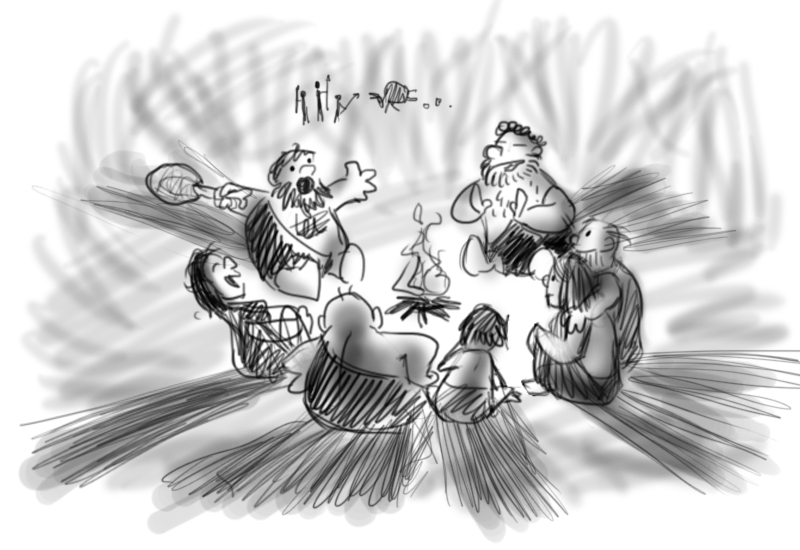
  • Culture is a shared, active process of making meaning.
  • Ethnography explains the real-world complexity of human behavior.
  • Ethnography focuses on identity.
  • Ethnography gives us the opportunity to observe and understand processes as they happen.
As an educator, I believe that each environment is specific to a time and place and that there are no coincidences.  Life is a chain reaction of events, and in order to understand outcomes, whether they are intended or not, we need to understand the events that lead to them.

However, even ethnography has its weaknesses.  For example, we can use induction to make a hypothesis, but ethnography cannot test it for accuracy.  I'm thinking that I can use ethnography to make a hypothesis about the paradox of teacher leadership or even students' perception of academic success, but someone else would have to create the experiment to test my hypothesis.  Additionally, ethnography tends to include long lists of "stuff" to complete:  interviews, focus groups, and observations that all include field notes.  Eventually, those field notes will need to be coded and then officially recorded, and, to some, this process can seem daunting.  However, I think that it sounds exciting and not unlike other tasks that I've already completed in my professional career.   As a National Board Certified Teacher, I've had to record my own teaching, observe my own teaching, code specific events in field notes, and then write reflections on my observations.  I've also had to evaluate mentees and other Initially Licensed Teachers using a similar processes.  I'm already comfortable with this methodology (unlike those methodologies under the positivistic umbrella).

What I love most about ethnography is that it is designed to make meaning of everyday events.  Moreover, the results can be recorded in the form of not only the full-length monograph but also a photo essay, fiction, and even poetry.  (No worries--I would not dare write poetry in a dissertation.)

Tuesday, September 30, 2014

Reflection: The Power and Pathologies of the Ways of Knowing

The great thing about our ways of knowing is that we NEVER use only one way.  As a knower, I am constantly recieving (or gaining) input throuh my sense perception, my ability to reason, the use of language through communicaiton, and even my emotional state.  For example, when we sit in the doctoral room and have our discussions, each of us enters the room with a current emotional state. Unless one of us stays the night in the room and slept all day, each of us has emotional encounters throughout the day that may shape how we feel.  Additionally, we use perception to see each others' reacitons to material and hear responses to both concrete and abstract questions.  We reason with each other and even ourselves to make connecitons and conclusions, and then we use language to responed with a hopefully appropriate answer.  We use these ways of knowing to gain knowledge about research and the world around us.

However, each of these ways of knowing can create problems of knowing for us throughout this process.  For example....let's say that I have a faculty meeting before our Tuesday session and that faculty meeting focusses on English II End-of-course data and standard 6 of the NC teacher evaluaiton rubric.  Let's now say that the topic of discussion invovles the importance of data and a "hard" scientific approach to reserach and how it's the BEST way to come to reach conclusions or generalizations.  If this were to happen (and it doesn't because I have to leave too early to attend faculty meetings on Tuesdays), my emotions would clearly hinder my gaining of essential knowledge.  My emotions and reason are so closely linked, that one can get in the way of the other.  Sometimes I let reason win, and sometimes I let emotion win, but must of us teater somewhere in the middle of the Emotion-Reason continuum.

In terms of reserach, the positivists say that emotion serves no purpose in the gaining of knowledge, but what I find ineteresting is that a researcher would not be interested in that data if he or she were not somehow attached to this information emotionally.  If we don't care about it, what's the point in knowing it.  I find it interesting that I started to write this post before watching Kitchen Stories, but I left the post at this point so that I could watch the film.  Apparently the creators of this film agree. It's human nature to want to know people's stories, and we feel awkward and unnatural being positivistic. Emotion both hinders the empirical research but then inspires the observed to do the observations.

Monday, September 15, 2014

There is a story in there somewhere!

How compelling do you find the argument and analysis in The Sprit Level?  What are the methodological strengths and limitations?

First off, I want to explain that I am truly enjoying The Spirt Level and it's message.  I support the message and think that educators (at all levels) can glean much from reading this piece.  I think that the hard data is convincing.  Obviously, the strengths lie in the data, and the correlations of equity (or disparity) and reading rate, happiness, and even task completion rate all make sense to me.

...HOWEVER...

I honestly can't help but think that there is so much more that they are leaving out.  For every scenario that compares two variables, I have a list of questions that I would like to know.  For example, what about relativity and cultural differences?  Behind each chart lies a question and a story that explains that question.  

Data is limited by the human condition.  Behaviors can be counted, and beliefs and values can be communicated, but can readers really assume that income inequality causes all of the issues outlined in the book?  Here the process of induction, moving from the specific to the general, is fallible, for I suspect that the assumption of causation is simply too extreme.  I would like to view the data in its "raw" stage and make that determination on my own rather than make assumptions or generalizations based on the text. 

Is the correlation less compelling?  No, not really.....I simply believe that the data can take us only so far and that we need to share more of the human story in order to create new generalizations.  (Induction is a complex, beautiful thing!)


Saturday, September 6, 2014

I don't do numbers.

You've asked the question, "What's my paradigm?"

So...My life revolves around words. In fact, I had to warn my stats professor during our first encounter of our doctoral term that I haven't taken a math class since I was eighteen, and I really DON'T DO NUMBERS. I don't know exactly how this happened, for I was a very strong math student in secondary school. I guess something happened during my first go round with college: Math simply was not fun, and everything that incorporated the use of rich words was fun. I enjoyed learning new languages and cultures, how art is connected to time and place, and of course that literature is a reflection of the human condition. 

At first, I knew that I wanted to teach, but I didn't know what to teach. Surprisingly, my advisor in college said that I should be a math teacher, because my standardized math scores were very strong--he said that I'd be good at it. However, the thought of spending every day teaching kids to do something that was not fun sounded miserable to me. (The data, or the math, lied.) Don't get me wrong, I'm not dissing the importance of math--I get it. I know that we need it and that it's central to everything from science to archetypes. I simply do not see the joy in it.

Therefore, my lens at this point is definitely not positivist. I will not, however, completely disregard post positivism, for I am willing to admit that empiricism is important in research. My problem (or my strength, depending on how you look it it) is that I believe that everything tells a story--even data. In fact, I believe that data sometimes creates more questions than it answers. I understand that humans are unique in that they can think one thing and respond accordingly on one day and then completely change their minds on the following day.

I guess that I haven't really answered the question yet, but I always tell my students that knowing what you don't want to do is just as important as knowing what you DO want to do.

 I’m excited about the direction that I’m moving, and we'll see where I land.